Okaloosa County court records are official legal documents created during court activity within Okaloosa County, Florida. These records contain case files that document civil matters, criminal proceedings, traffic violations, and family-related disputes recorded through the local court system. Okaloosa County Court records, Florida, also reflect filings, motions, hearings, rulings, and final judgments stored for long-term reference. Each record forms part of a structured court database managed by the county’s Clerk of Court office, which organizes legal documents in a consistent format tied to individual case numbers and courtroom activity history.
Okaloosa County court records represent a structured collection of legal documents stored within the county court database and maintained for recordkeeping across different case types. Civil case files, criminal case files, and probate documentation are recorded with detailed entries that reflect filings, court orders, and case progression updates. The Clerk of Court system manages these records through organized indexing of legal documents linked to each proceeding. Public records availability supports visibility of case files for civil, criminal, and traffic matters recorded in the county system. The court database stores structured data that reflects courtroom actions, filings submitted by parties, and outcomes recorded by judges, creating a complete legal record trail for each case processed in Okaloosa County.
What are the Okaloosa County Court Records?
Court records in Okaloosa County contain official case files, filings, and legal documents produced during court proceedings. These records are stored in a structured court database that tracks civil, criminal, and traffic matters across different court levels. They serve as a public reference point for case history, charges, rulings, and procedural updates tied to legal matters handled within the county court system.
What Court Records Include in Okaloosa County
Court records in Okaloosa County contain a wide range of legal documents created during a case lifecycle. These documents form the official case files used by clerks, attorneys, and the court.
Each record may include:
- Case filings submitted by plaintiffs or defendants
- Court orders issued by judges
- Hearing schedules and docket entries
- Judgments and final rulings
- Evidence lists and motions submitted in hearings
- Summons and notices were served to the involved parties
These legal documents form part of the official court database, which keeps track of all case activity. Records may differ based on case type, but each entry follows a structured filing process. Users often rely on these files to review case history, verify legal status, or confirm procedural steps taken during litigation.
Civil, Criminal, and Traffic Case Files
Okaloosa County separates court records into civil, criminal, and traffic categories. Each category contains different legal case files with specific procedures and documentation styles.
Civil case files involve disputes between individuals, businesses, or organizations. These may include:
- Contract disputes
- Property disagreements
- Small claims cases
- Debt-related filings
Criminal case files relate to offenses against state law. These records often contain:
- Arrest reports
- Charging documents
- Trial transcripts
- Sentencing records
Traffic case files cover violations involving driving laws. These include:
- Speeding citations
- DUI-related filings
- License suspension records
- Traffic ticket dispositions
Each category feeds into the court database, which organizes records for retrieval and case tracking. Legal documents within each file type follow strict formatting rules set by court clerks. This structure helps maintain consistency across all record types.
How to Search Okaloosa Court Records Online
Okaloosa court records can be searched online through the county’s official case lookup system. Users can find civil, criminal, traffic, and probate case details using either a name search or a case number search. The online system connected with the Okaloosa County Clerk of Court helps display public court case information, docket activity, and hearing history.
Step: Process for Okaloosa Clerk Court Records Search
The Okaloosa clerk court records search process follows a structured flow that helps users locate case details quickly through the official online portal. The system works around indexed court data tied to case filings and party names. Users begin by opening the official court records search page linked to the county clerk database. After that, the search parameters can be entered based on available details.
Basic steps for court case lookup:
- The official Okaloosa Clerk online case search system https://okaloosaclerk.com/
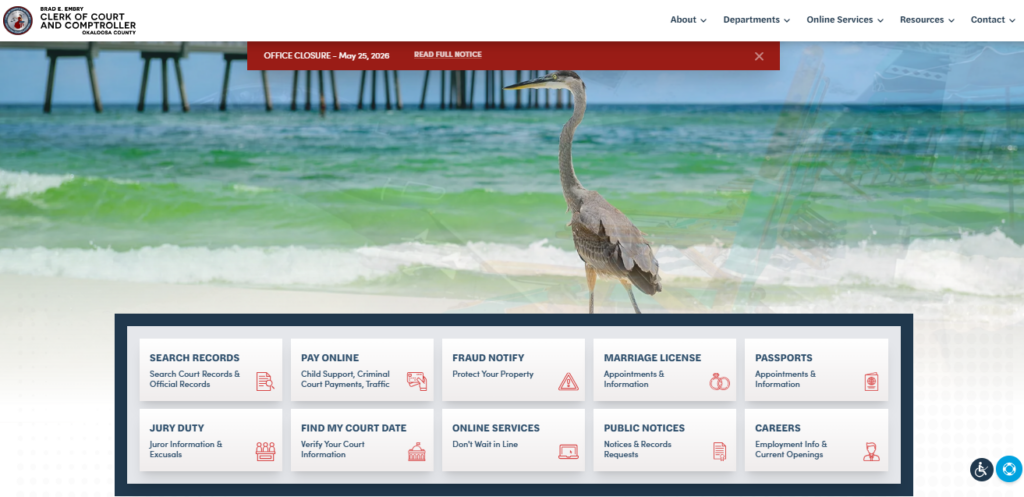
- Select search type, such as name search or case number search
- Enter full name, business name, or case ID
- Select a case category like civil, criminal, traffic, or probate
- Submit the search request
- Review matching records from the results list
The system displays court proceedings, filing dates, charges, and hearing updates. Each case record may include docket entries, judge assignments, and case status updates.
ClerkQuest System for Online Case Lookup
The Okaloosa court database is commonly powered through a Clerk-based digital platform often referred to as ClerkQuest or the Clerk Records Search system. This system organizes court data into searchable indexes linked directly to official filings.
The ClerkQuest system works as a central database for:
- Civil and criminal case filings
- Traffic citation records
- Probate and family court matters
- Court hearing schedules
- Case status updates
Each record inside the system connects to a docket trail, which shows how a case has progressed through the court process. Users can check filing dates, motions, and scheduled hearings in real time. The platform also supports court case lookup using multiple filters. These filters help separate high-volume data into smaller result sets. This improves clarity when reviewing Okaloosa clerk court records tied to multiple years or parties.
Name Search vs Case Number Search in Court Records
Two main methods exist for searching Okaloosa court records online: name search and case number search. Each method serves different needs depending on available information.
Name Search Method
Name search works when only a person or business’s name is available. The system scans all records linked to that name and returns possible matches.
This method is commonly used for:
- Background review of court activity
- Checking multiple cases tied to one party
- Reviewing civil or traffic history
- Broad online case lookup without case ID
Name search results may show several entries, especially for common names. Filters like date range or case type help narrow results.
Case Number Search Method
Case number search provides a direct match. Each court filing has a unique identifier assigned at the time of entry.
This method is used for:
- Fast retrieval of a single case
- Checking case tracking updates
- Viewing full docket history
- Confirming court hearing schedules
Since the case number is unique, the results appear more precise. This reduces extra filtering and improves accuracy during searches.
Docket Search and Case Tracking in Okaloosa Court Records
Docket search plays a key role in reviewing how a case moves through the court system. A docket lists all filings, motions, hearings, and decisions tied to a case.
In Okaloosa court records, docket entries often include:
- Filing submissions
- Court motions and responses
- Hearing dates and outcomes
- Judge notes and rulings
- Final judgment entries
Each entry builds a timeline of court proceedings, showing how the case progresses step by step.
Types of Court Records Available in Okaloosa
Court records in Okaloosa County include multiple record categories that reflect different legal matters handled by the courts. These records cover civil disputes, criminal cases, traffic issues, and probate matters. Each category contains case files, judgment records, and filing records tied to specific proceedings. Public users often review these records to check case status, verify court activity, or confirm past rulings. The structure of each record type depends on the case category and court level involved.
Civil Court Records
Civil court records cover disputes between people, businesses, or organizations. These cases do not involve criminal charges. They often relate to money claims, contracts, property issues, or personal disagreements. Civil files usually contain case files that track each stage of the dispute. These files include complaints, responses, motions, and final rulings. Many civil matters end with judgment records, which show court decisions and ordered outcomes.
Civil record types include:
- Contract disputes between parties
- Property damage claims
- Small claims cases
- Debt recovery filings
- Landlord and tenant disputes
Civil filing records show when a case started and what documents were submitted first. These filings help track how a case moves through court steps.
Criminal Records
Criminal records reflect cases where a person is charged with breaking state or local law. These cases may range from minor offenses to serious felonies. Each criminal case includes detailed case files that document arrests, charges, court hearings, and sentencing outcomes.
Criminal records typically include:
- Arrest reports and charging documents
- Court hearing transcripts
- Evidence summaries
- Sentencing details
- Judgment records from final rulings
These records show how the court processed the charge from filing to final decision. Filing records confirm when the charge entered the court system and which court handled the matter.
Traffic Violation Records
Traffic violation records cover driving-related offenses handled through county or municipal courts. These cases are usually less serious than criminal matters but still carry legal penalties.
Traffic records often include:
- Speeding tickets
- Reckless driving charges
- DUI-related court actions
- License suspension cases
- Citation processing details
Each traffic case includes case files that track citations, court appearances, and penalty decisions. Many cases end with judgment records showing fines, point assessments, or court orders.
Probate Records
Probate records relate to the legal handling of estates after death. These cases are processed through the court to distribute property, validate wills, and appoint representatives.
Probate case files often include:
- Wills and estate documents
- Petitions for estate administration
- Asset inventories
- Creditor claims
- Court orders on asset distribution
Probate judgment records show final decisions on estate distribution and executor approval. These records confirm how assets were divided under court supervision.
Okaloosa County Clerk of Court System
The Okaloosa County Clerk of Court acts as the central office responsible for managing court documentation, filings, and official record tracking within the county judicial structure. This office supports the official court system by handling case paperwork, maintaining records, and processing legal filings tied to civil, criminal, family, and traffic matters. It also plays a key role in organizing Okaloosa clerk court records, which include active and historical case information used by courts, attorneys, and the public for reference and verification.
Role of Clerk of Court in Okaloosa County
The Clerk of Court serves as the administrative center of the county’s judicial operations, handling essential tasks that keep court activities documented and organized. This office processes filings submitted for civil disputes, criminal charges, and family-related matters, while also recording judgments, hearing outcomes, and official court actions. It works closely with judges, attorneys, and law enforcement agencies to maintain consistency in case documentation. Traffic citations, fines, marriage licenses, and certified legal records also pass through this office for verification and storage. Through these responsibilities, the clerk helps maintain structure within the official court system, making sure each case entry is properly recorded and updated as proceedings continue.
Record Maintenance and Okaloosa Clerk Court Records System
The record maintenance system in Okaloosa County focuses on organizing, storing, and updating all legal case files handled by the court. The Okaloosa clerk court records system includes civil, criminal, traffic, and family-related documentation, stored in both digital databases and physical archives. Each case is assigned a structured file that tracks filings, hearing notes, and final judgments. Updates are entered after every court action, keeping information consistent across the system. This organized method supports case verification and historical reference for legal professionals and the public. The system also separates record types based on case category, which helps maintain clarity and reduces duplication or missing entries in court documentation.
Public Viewing Rules in the Official Court System
Public viewing of court records in Okaloosa County follows Florida state regulations that define what information can be shared and what remains restricted. Many civil, traffic, and non-sensitive criminal records are part of the public record, while juvenile cases and sealed documents remain protected under court orders. Requests for detailed files may require identification and involve standard copy fees set by the clerk’s office. The official court system follows strict data handling rules to balance transparency with privacy protection, allowing individuals to review eligible court records while restricting confidential or sensitive information from public release.
Arrest & Criminal Records Search
Arrest and criminal records in Okaloosa County come from different systems and should not be treated as the same source. Arrest information reflects detention events, while court records show official case proceedings and outcomes. Users often mix jail data with court case details, which leads to confusion during an inmate search or criminal case search.
Arrest Records vs Court Records in Okaloosa County
Arrest records and court records serve different purposes within the public record system. Arrest data comes from law enforcement agencies at the time of detention, while court records are created after a case enters the judicial system. Arrest records usually show early-stage information such as booking details. Court records reflect legal actions taken by judges, attorneys, and case filings.
Differences include:
- Arrest Records
- Booking date and time
- Charges at arrest
- Jail intake location
- Arresting agency details
- Often listed in an arrest database
- Court Records
- Case number and filing date
- Court hearings and motions
- Judge rulings and sentencing
- Final disposition of the case
- Found in a criminal case search
Arrest records may change after review, while court records remain tied to official proceedings. That difference matters when checking legal status or charge updates.
Jail System vs Court System Separation
The jail system and court system operate separately in Okaloosa County. Each system stores different data and serves different roles in criminal processing. The jail system handles custody and intake. The court system manages hearings, trials, and legal decisions.
Jail system records often include:
- Current inmate location
- Booking number
- Mugshot data
- Bond or bail status
- Short-term holding details
These records are often used in an inmate search to confirm if a person is currently detained.
Court system records include:
- Filed criminal charges
- Scheduled court dates
- Evidence filings
- Judge decisions
- Sentencing outcomes
A jail record may show a person in custody, but the court record explains why they are there. Both systems update at different speeds, which can lead to temporary mismatches in public data.
Criminal Case Search and Inmate Search Options
A criminal case search focuses on legal case progress, while an inmate search focuses on current detention status. Both tools are used for public record checks, but they return different results. Users searching Okaloosa County records often rely on structured databases that separate arrest data from court filings.
| Search Type | What It Shows | Common Source |
|---|---|---|
| Inmate Search | Current custody status, booking info | Jail roster system |
| Arrest Database | Recent arrests, charge details | Law enforcement records |
| Criminal Case Search | Court hearings, rulings, outcomes | Court clerk system |
The arrest database updates more frequently during law enforcement activity. Court systems update when filings or hearings occur.
Court Docket & Case Status Tracking
Court docket systems in Okaloosa County Court show official listings of filed cases, scheduled hearings, and case actions. Case status tracking helps people view current progress, upcoming dates, and recent updates tied to a court matter. This section explains the meaning of docket search, hearing updates, and case progress tracking in a clear way for users reviewing court hearing records or using a case tracking system.
What docket search mean in the Okaloosa County Court
A docket search refers to a structured listing of court cases stored in the court hearing records system. It shows what cases are active, closed, or scheduled for review.
Each docket entry usually includes:
- Case number and filing date
- Party names involved in the case
- Assigned judge or division
- Scheduled hearing dates
- Case type, such as civil, traffic, or criminal
The court docket works like a case timeline. It records each step from filing to final decision. Users often rely on it for quick case tracking system checks without contacting the clerk’s office.
Hearing updates and case status details
Hearing updates show when a case is scheduled or rescheduled. They also reflect cancellations or changes in courtroom timing. Case status tracking shows the current stage of a case inside the court process.
Case status labels include:
- Pending – case is active and waiting for a hearing
- Scheduled – hearing date is set
- Disposed – case has a final decision
- Continued – hearing moved to a new date
Court hearing records update when filings, motions, or rulings are entered. These updates help users follow progress without missing important changes.
| Case Status | Meaning | What Users See |
|---|---|---|
| Pending | Active case | No final decision yet |
| Scheduled | Hearing set | Future court date listed |
| Disposed | Case closed | Judgment entered |
| Continued | Date changed | New hearing date shown |
Frequent case status checks help reduce confusion about hearing dates and court movement.
Case progress tracking system and record flow
A case tracking system in the Okaloosa County Court organizes case movement from start to finish. It pulls data from court hearing records and updates docket entries in real time based on filings.
Case progress tracking often includes:
- Filing entry updates
- Motion submissions
- Judge rulings and orders
- Hearing results
- Final case closure details
Users can follow a case step by step through the system. Each update reflects a new stage in the court process, showing how far the case has moved.
Are Okaloosa Court Records Public?
Okaloosa County court records are treated as public under Florida law. Most case files and docket details can be viewed under state transparency rules. Some records stay restricted for privacy or legal protection. Florida law supports openness in court matters. Still, certain sensitive details remain protected from public view.
Florida public records law in Okaloosa County
Florida follows strong transparency rules under the Florida public records law, which supports public review of government-held records. Court documents in Okaloosa County fall under this framework and are regulated through state-level court administration policies. Requests for court files often involve FOIA requests and formal record inquiries submitted to clerks. These requests help confirm case details, filings, and hearing dates. The system also supports transparency data reporting, which shows how courts manage case flow and filings across civil, criminal, and traffic matters.
Court clerks in Florida maintain records that relate to filings, judgments, and scheduled hearings. These records form part of official judicial documentation and are preserved for legal reference and public review purposes.
What Okaloosa court records show and what stays private
Okaloosa County court records contain a wide range of case-related details. At the same time, certain records remain sealed or restricted by law to protect privacy and sensitive legal matters.
Common record types that may be viewed:
- Civil case filings and motions
- Criminal case dockets and charge details
- Traffic violation records and hearing dates
- Final judgments and court orders
- Probate case filings in limited form
Records that stay restricted:
- Juvenile case files
- Sealed court orders
- Mental health commitment records
- Victim identity details in protected cases
- Expunged or set-aside criminal records
Court systems balance transparency with privacy protections. Sensitive cases remain restricted under state rules, while most routine case information stays documented in official court databases.
(FAQs) About the Okaloosa County Court
Okaloosa County court records are usually checked through official clerk systems that list civil, criminal, traffic, and probate cases in one place. Most users look for quick case lookup help and simple case search help when trying to confirm case details or status.
How to find court records in Okaloosa?
Court records in Okaloosa County are available through the Clerk of Courts database, where users can search civil, criminal, traffic, and family cases by entering a case number or party name, and results show basic case details such as filing date, court division, status, and hearing updates, which makes the court lookup guide process easier for public record checks.
Are court records free?
Most basic court record searches in Okaloosa County are free through public online systems, allowing users to view case summaries, party names, and docket entries without payment, although certified copies, transcripts, and full official documents usually require clerk fees that vary by document type and page count.
Can court records be searched by name?
Okaloosa County court records can be searched by name using first and last name entries in the official system, and the results may include multiple matches for common names, so filters like case type, year, or middle initial are often used to improve case search help and locate the correct record.
How accurate are online court records?
Online court records in Okaloosa County are generally reliable because they are pulled from official clerk updates, but timing differences can occur since new filings may take time to appear, and older or closed cases may show limited details, so certified documents remain the most verified source for formal use.
Can Okaloosa court records show criminal history?
Okaloosa court records can show criminal case history when the records are part of the public court system and not sealed or restricted by law. These entries usually include charges, filing dates, case status, and final court outcomes for eligible cases, which helps users perform case searches for background checks and general public record review.